That I May Heal You
Grove Park 9th Ward Sacrament Meeting · May 18, 2025
The Atonement does not just heal the sinner. It heals the sinned against.
Christ died for men precisely because men are not worth dying for; to make them worth it.
—C. S. Lewis
Good morning, brothers and sisters. In the April 2025 general conference, Elder S. Mark Palmer delivered a message titled “Return unto Me … That I May Heal You.” He taught that no matter how far we feel from God, it is never too late to return to Jesus Christ and find healing through His Atonement.
Today I want to focus on one part of that healing: forgiveness. Forgiveness is not only a kindness we extend to others. It is a divine principle woven into the Savior’s Atonement. Through His example we learn how to forgive those who have hurt us, even in the deepest ways, and in doing so we find peace.
As I approach my fortieth year, I am prone to reflect on my life and its trajectory. I reflect on fatherhood, both being a father, and the experiences I have had with my own earthly fathers. I would like to share some of that with you: a personal story about overcoming pain from my past and learning to forgive. I apologize in advance if this feels like oversharing. My hope is that we will feel the Savior’s love in His invitation to return to Him, no matter our burdens, and allow Him to heal us through forgiveness.
With that in mind, I’d like to share this quote from Elder Richard G. Scott:
Some matters are so sensitive and intensely personal and can awaken such disturbing feelings that they are seldom mentioned publicly. Yet, if tenderly and compassionately treated in the light of truth, discussion of these matters can bring greater understanding, with the easing of pain, the blessing of healing, and even the avoidance of further tragedy.1
Christ’s Atonement and Forgiveness
The Atonement of Jesus Christ is the greatest act of love in human history. It covers not only our sins but also our sorrows, our wounds, and our heartaches. Elder Palmer emphasized that Christ’s invitation to “return unto Me” is a promise that He can heal us, no matter what we have experienced. Doctrine and Covenants 130 teaches that “when we obtain any blessing from God, it is by obedience to that law upon which it is predicated.”2 To experience the full healing power of the Atonement, it is required at times of us to forgive others, just as Christ forgave those who sinned against Him.
Consider the Savior’s words on the cross, suffering at the hands of those He had not wronged and whom He had, in fact, come to save: “Father, forgive them.”3 Despite unimaginable suffering, Christ extended forgiveness to those who mocked, tortured, and crucified Him. This was not only a moment of divine compassion. It was a pattern for us to follow. His forgiveness shows that no offense is too great, no pain too deep, for His healing power to overcome. Elder Palmer taught that when we return to Christ, we allow Him to take our burdens. Forgiveness is part of that process. When we forgive, we release the chains of resentment and anger that bind us, opening our hearts to the Savior’s peace. The Atonement does not just heal the sinner. It heals the sinned against; those who carry the scars of others’ choices.
A Child under the Laundry
Let me share a personal experience that has tested my ability to forgive.
I was born Justin Michael Rippee to parents who, by all accounts and memory, did not really want me. That home was not a place of safety. I have some memory of the abuses I and my brothers suffered at the hands of parents lost to the grip of addiction. At times in the past I have said that the only things my biological father ever really gave me were scars. As a child, I felt powerless, afraid, and confused.
I remember one instance in particular. I must have been three or four. I do not recall the inciting incident, and honestly, there may not have been one. I was hiding under a pile of dirty laundry, biting my fist, trying to stifle sobs, afraid I was going to be found. Unfortunately, I still bear the scar of my failure that day.
Though eventually I was taken away by the state, adopted, and had my name changed by court order, those wounds—both seen and unseen—followed me into adulthood, manifesting as distrust, fear, and a deep sense of unworthiness. For years I carried that pain like a heavy backpack. Why would someone who was supposed to love me cause so much pain? The fear I felt as a child eventually turned to vengeful anger.
Navarre
When I was adopted my parents thought it’d be a good idea to let my older brother pick my middle name. His favorite film at the time was Ladyhawke, so he picked the name of the main character, Navarre. I am going to spoil the movie for you; if you haven’t seen it by now, that’s on you! As I grew up, I identified with Navarre in the film. As a child I saw a man bent on vengeance who gets even in the end, taking out the bad guy with his sword. But the anger I held onto didn’t bring peace, it only deepened my hurt and even caused me at times to hurt those around me. I felt stuck, unable to move forward. As I grew and matured, my life became a constant tug-of-war between that deep-seated desire for vengeance and my yearning to follow Christ and feel the love and forgiveness I so desperately wanted. It felt like I was being spiritually ripped apart.
The Church teaches that vengeance is contrary to the gospel of Jesus Christ. The emphasis is forgiveness, love, and leaving judgment to God. The Savior is unequivocal:
I, the Lord, will forgive whom I will forgive, but of you it is required to forgive all men.4
My unrighteous desires for some kind of vengeance clashed with the Savior’s call to forgive. I knew that only through Christ’s Atonement could I find peace. I knew I needed to find a way to let go of my anger and trust in God’s justice.
Rewatching Ladyhawke as an adult, I noticed something I had missed as a boy. Navarre and Isabeau tried to walk away. Once they had accomplished their task of confronting the villain and breaking the curse, they turned to leave. The conflict was escalated by the villain and we get our obligatory vengeance, but the truth of the matter is that vengeance was not the goal. Healing and walking away was.
In time I have come to realize that forgiveness was not about excusing my father’s actions. It was about freeing myself from the burden of resentment. Often I knelt in prayer, pleading for strength to do what felt impossible. The journey to forgive was not quick or easy. It began with small steps: praying for my father, trying to understand his own struggles, and studying the Savior’s life. I read about Christ forgiving those who betrayed Him, and I felt hopeful that He could help me do the same. During this period of struggle, Doctrine and Covenants 122:8 became my favorite scripture:
The Son of Man hath descended below them all. Art thou greater than he?5
Over time I started to see my father not only as the source of my pain but as a flawed human being who needed the Savior’s healing, just as I did.
In 3 Nephi 12 we are taught:
Therefore, if ye shall come unto me, or shall desire to come unto me, and rememberest that thy brother hath aught against thee—Go thy way unto thy brother, and first be reconciled to thy brother, and then come unto me with full purpose of heart, and I will receive you.6
I worked hard to forgive my biological father, and over time I began to let go. We reconnected a few years ago on social media. There was some remorse in his messages to me, but also a clear refusal to take any responsibility. That made me pretty angry, though I managed at least to keep that to myself. Regardless, I never talked to him again. He passed away three years ago, and I flew out to California with the intention of helping take care of things. However, though I had not seen him since I was taken as a child, I decided instead to spend time with friends and family in the area.
I am told nobody claimed the body, and nobody came to see him. At the time I felt some vindication. That feeling, however, quickly turned to shame. I had allowed those old feelings of resentment and anger to win again, and I knew they would continue to corrode my soul. Elder Palmer’s words resonate deeply with that experience: “It is not too late for you to come back.”7 At the time I knew I had to return to Christ. I had to bring Him my broken heart, give up my anger, and trust Him to heal me.
I was pretty beat down. With my biological father gone, I felt like I had failed in my attempt to forgive. I no longer carried the bitterness that once defined me, but I felt as if I could no longer fully offer that forgiveness, and I would never be able to heal. In all this I want to share these words from Elder Jeffrey R. Holland:
“Forgive, and ye shall be forgiven,” Christ taught in New Testament times. And in our day: “I, the Lord, will forgive whom I will forgive, but of you it is required to forgive all men.” It is, however, important for some of you living in real anguish to note what He did not say. He did not say, “You are not allowed to feel true pain or real sorrow from the shattering experiences you have had at the hand of another.” Nor did He say, “In order to forgive fully, you have to reenter a toxic relationship or return to an abusive, destructive circumstance.” But notwithstanding even the most terrible offenses that might come to us, we can rise above our pain only when we put our feet onto the path of true healing. That path is the forgiving one walked by Jesus of Nazareth, who calls out to each of us, “Come, follow me.”8
Why Forgiveness Matters
Why is forgiveness so essential to the Atonement? Elder Palmer taught that returning to Christ allows Him to heal us, and forgiveness is a critical part of that return. When we hold onto anger, we block the Savior’s healing power. It is like refusing to let a doctor treat a wound. We may think we are protecting ourselves, but we are only prolonging our own pain.
The Lord commands us to forgive not because it is easy, but because it is liberating. In Matthew 6 the Savior taught:
For if ye forgive men their trespasses, your heavenly Father will also forgive you: But if ye forgive not men their trespasses, neither will your Father forgive your trespasses.9
Forgiveness aligns our hearts with the Savior’s, allowing us to fully partake of His Atonement. Christ’s example of forgiving those who crucified Him shows that forgiveness is not about fairness. It is about freedom. When we forgive, we hand our pain to the Savior, who bore it in Gethsemane and on the cross. He does not ask us to carry it alone. Elder Palmer’s message reminds us that no matter how deep the hurt, Christ’s Atonement is deeper still.
The Font
Then one day it clicked. I was with my adopted father west of Spanish Fork on top of the hill near Lincoln Beach. I was thinking about the differences between the two men, my biological father, and my adopted father. One abused me, and the other chose me, one gave me scars and anger, and the other gave me safety and the gospel path. We were looking out over the valley and my dad remarked how from up there it’s kind of difficult to get your bearings. We rely on I-15 a lot to determine where we are, but it’s a thin ribbon that’s difficult to make out from there. Having been up there with the same question before, I said “Dad, look for the temples, they lead the way. You can see Payson, Provo, and Timp from up here, they help me find my bearings.” No sooner had I said that than the spirit hit me full force, and I knew what I needed to do.
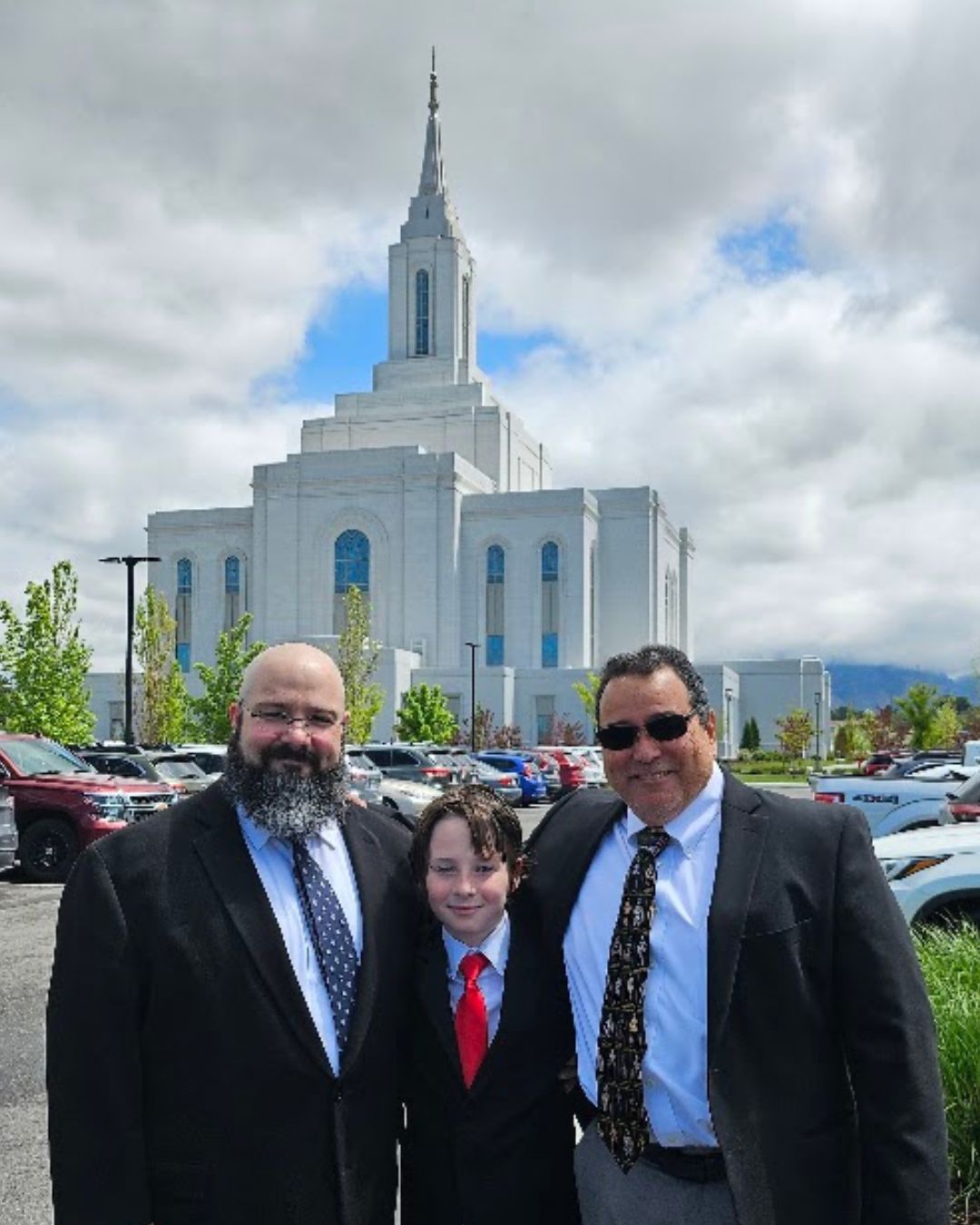
Two weeks ago I took my son Marek to the temple for his first time ever, and I had the privilege of baptizing him on behalf of my biological father, Jerry Steven Rippee. I could not claim his body, or tell him I forgave him, but I could still claim the covenant and humble myself in his service. The work of forgiveness did not end when my father died. In some ways that is when it became possible to finish.
His Arm Is Extended Still
In many ways I am still that child hiding under dirty laundry. Even so, I echo these words of Elder Holland:
I testify that forgiving and forsaking offenses, old or new, is central to the grandeur of the Atonement of Jesus Christ. I testify that ultimately such spiritual repair can come only from our divine Redeemer, He who rushes to our aid “with healing in his wings.” We thank Him, and our Heavenly Father who sent Him, that renewal and rebirth, a future free from old sorrows and past mistakes, are not only possible, but they have already been purchased, paid for, at an excruciating cost symbolized by the blood of the Lamb who shed it.10
I testify of the tranquility to the soul that reconciliation with God and each other will bring if we are meek and courageous enough to pursue it.11
Christ lives, and His Atonement is real. Through His infinite love He offers healing to all who return to Him, no matter how broken or burdened we feel. Forgiveness is not just a gift we give others. It is a gift we give ourselves, made possible by the Savior’s sacrifice. I know this because I have felt His healing in my own life as I learned to forgive my father and find peace.
Whatever pain you carry, bring it to the Savior. He will heal you, just as He has healed me.
Christ died for men precisely because men are not worth dying for; to make them worth it.12
His arm is stretched out still.13
In the name of Jesus Christ, amen.
Notes
- Richard G. Scott, “To Heal the Shattering Consequences of Abuse,” Apr. 2008 general conference.
- Doctrine and Covenants 130:21.
- Luke 23:34.
- Doctrine and Covenants 64:10.
- Doctrine and Covenants 122:8.
- 3 Nephi 12:23–24.
- S. Mark Palmer, “Return unto Me … That I May Heal You,” Apr. 2025 general conference.
- Jeffrey R. Holland, “The Ministry of Reconciliation,” Oct. 2018 general conference. See also Luke 6:37 and Doctrine and Covenants 64:10.
- Matthew 6:14–15.
- Holland, “The Ministry of Reconciliation.” See also Malachi 4:2 and 2 Nephi 25:13.
- Holland, “The Ministry of Reconciliation.”
- C. S. Lewis, “Religion and Rocketry,” in The World’s Last Night and Other Essays (New York: Harcourt, 1960), 94.
- See 2 Nephi 19.
 ← Back to talks